
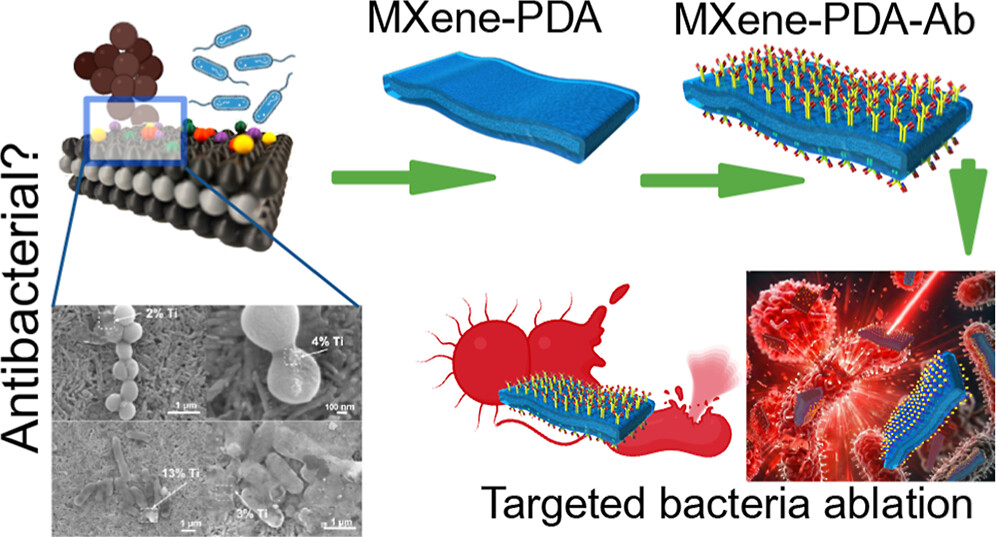
Do MXene nanosheets have intrinsic antibacterial properties?
A comprehensive investigation of high-quality Ti-, V-, and Nb-based MXenes demonstrates that these nanomaterials exhibit negligible intrinsic antimicrobial activity, while showing considerable promise for targeted photothermal antibacterial therapy. A recently published article in ACS Applied Nanomaterials reports the outcomes of a large-scale international research collaboration focused on reassessing the role of MXenes in antibacterial applications.
The study объединяет ведущих исследователей из University of Latvia, Carbon-Ukraine (производителя MXene Y-Carbon), Drexel University, Sumy State University, NanocarbonTech Poland, CSD Lab, NBMC Adam Mickiewicz University и Materials Research Center.
Leveraging combined academic and industrial expertise, the consortium performed a rigorous evaluation of MXene nanosheets, challenging prevailing assumptions regarding their inherent antibacterial properties and highlighting their effectiveness in advanced, antibody-functionalized photothermal antibacterial therapies. This work marks a significant step toward next-generation antimicrobial technologies, particularly for localized treatment strategies and combating drug-resistant infections, and underscores the importance of international collaboration in translating nanomaterials research from fundamental studies to biomedical applications.
Rethinking MXenes in Antibacterial Applications: From Intrinsic Effects to Smart Photothermal Therapies
MXenes constitute a rapidly expanding class of two-dimensional nanomaterials that have garnered substantial interest in recent years, particularly within biomedical research. Owing to their high biocompatibility, versatile chemical functionalization, and distinctive physical characteristics, MXenes have been extensively explored for a wide range of applications. Notably, numerous studies have described MXenes as effective antibacterial agents. Nevertheless, the coexistence of excellent biocompatibility with pronounced antibacterial performance prompts a fundamental scientific question: is it plausible for a material to be simultaneously non-toxic to mammalian cells while intrinsically harmful to bacterial systems?
Do MXenes Have Intrinsic Antibacterial Properties?
To resolve this apparent contradiction, a systematic investigation was conducted using high-quality, pristine MXene nanosheets—Ti₃C₂Tₓ, Nb₂CTₓ, V₂CTₓ, and Ti₃CNTₓ—with precisely controlled lateral dimensions. Comprehensive high-resolution structural and chemical characterization confirmed minimal oxidation and the absence of residual etching-derived impurities.
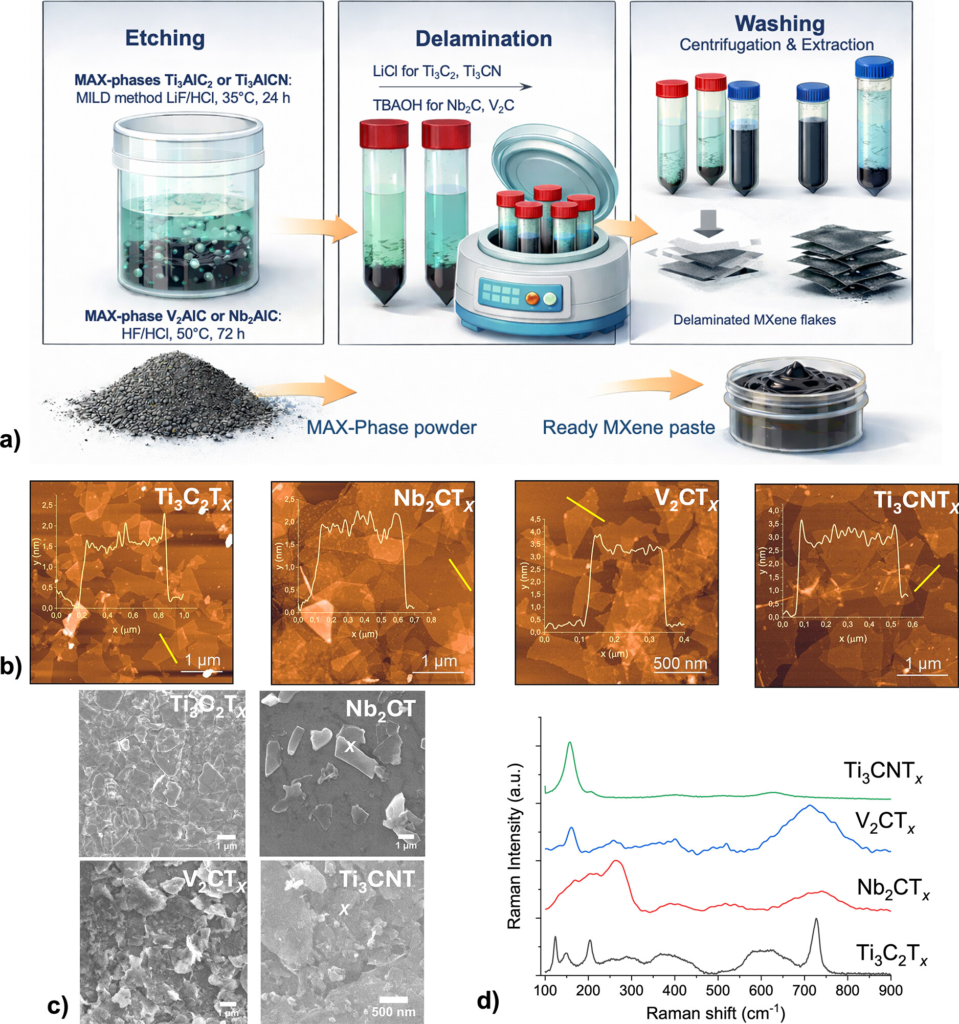
The antibacterial activity of MXenes was evaluated using an extensive set of in vitro assays—including disk diffusion, broth microdilution, time–kill analysis, ROS detection, and electron microscopy—alongside an in vivo wound model. Across all tests, pristine MXenes showed no significant intrinsic antibacterial effects at biologically relevant, non-toxic concentrations. Neither oxidative stress nor the proposed “nano-knife” membrane damage mechanism could be validated.
The study indicates that antibacterial effects reported in earlier literature likely arose from extrinsic factors such as residual etching chemicals, fluorine-rich surface groups, structural defects, or partial oxidation, rather than from the MXene materials themselves. When these variables are carefully controlled, pristine MXenes remain highly biocompatible but do not exhibit direct bactericidal activity.
Importantly, the absence of intrinsic antibacterial properties does not limit the biomedical relevance of MXenes. Instead, the work highlights MXene-enabled photothermal therapy as a powerful alternative. Ti₃C₂Tₓ MXenes efficiently convert NIR light into heat, enabling rapid and localized bacterial ablation in vitro and significantly improved wound healing in a rat model.
Targeted photothermal therapy using antibody-functionalized MXenes further demonstrated selective elimination of E. coli without affecting non-target bacteria, underscoring the precision of this approach.
Overall, the findings reposition MXenes as smart, externally activated platforms rather than inherent antibacterial agents. Their biocompatibility, tunability, and strong photothermal response make them promising candidates for next-generation antimicrobial technologies, particularly for localized infections, drug-resistant bacteria, and personalized therapeutic strategies.