
• First demonstration of bubble-assisted, sustainable electrochemically synthesized MXene
• EC-MXene retains excellent tribological performance despite predominantly O-terminated surfaces
• Formation of a stable tribofilm by EC-MXene, confirmed through experimental results and DFT calculations
The pursuit of sustainable solid lubricants is essential to minimize energy dissipation and wear in next-generation mechanical systems. Two-dimensional materials, particularly MXenes, have emerged as promising solid lubricants owing to their weak interlayer interactions, which facilitate low-friction sliding. Nevertheless, conventional MXene production depends on hazardous reagents such as hydrofluoric acid, posing significant environmental and safety challenges that hinder large-scale deployment.
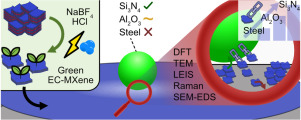
In this work, we present the first application of bubble-assisted electrochemically synthesized MXenes (EC-MXene) as eco-friendly solid lubricants. Compared with conventionally synthesized MXenes, EC-MXene feature oxygen-rich surface terminations and a markedly reduced fluorine content. When applied as coatings on AISI 52100 steel and evaluated against Si₃N₄, Al₂O₃, and steel counterparts, EC-MXene demonstrate outstanding tribological performance, with particularly superior behavior against Si₃N₄, achieving a low and stable coefficient of friction (COF ≈ 0.25).
Comprehensive surface characterization using SEM-EDS, Raman spectroscopy, TEM (SAED and EELS), and low-energy ion scattering (LEIS) reveals the formation of a durable tribofilm and a dynamic self-replenishing mechanism. This mechanism sustains lubrication by redistributing MXene flakes from debris accumulation zones to the active sliding interface. Density Functional Theory (DFT) calculations further confirm strong adhesion between EC-MXene and ceramic surfaces, corroborating the experimental tribological results. Load-dependent tests underscore the importance of interfacial adhesion and tribofilm ordering in preserving lubrication performance.
Overall, these results establish EC-MXene as a sustainable and environmentally benign alternative to conventional MXenes, offering comparable tribological performance through safer synthesis pathways. EC-MXene therefore represent a benchmark material for sustainable two-dimensional solid lubricants with wide-ranging potential in advanced mechanical and biotribological systems.